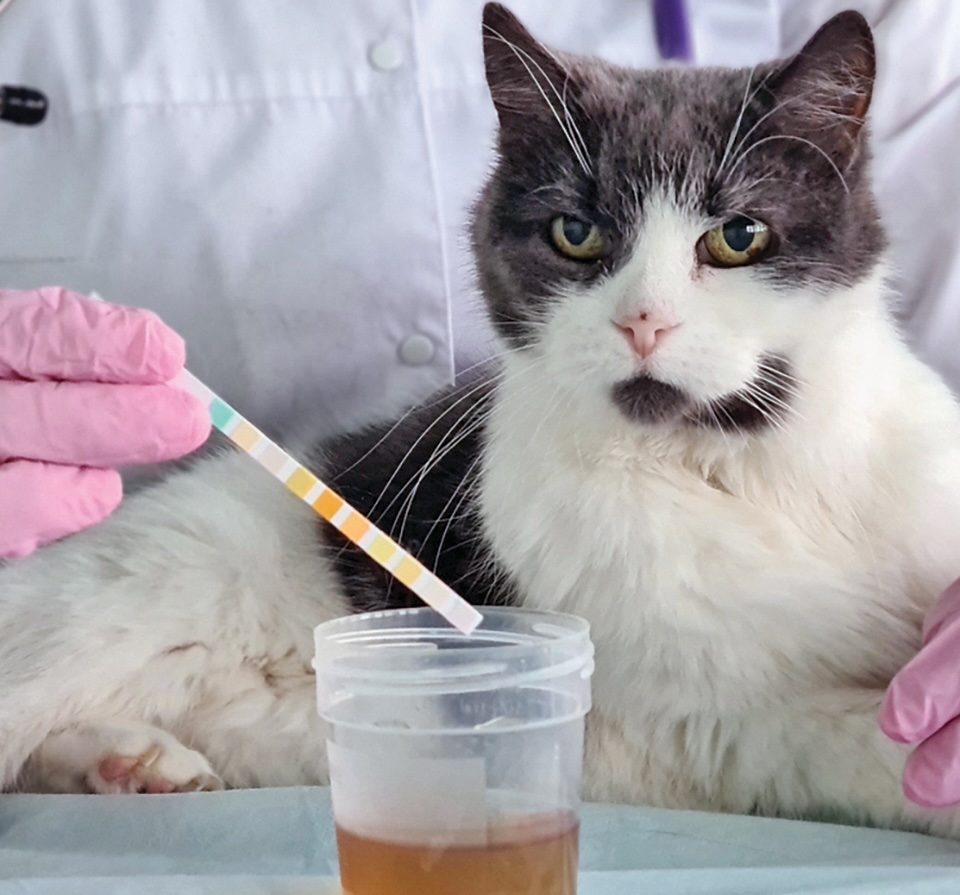
If your cat has been showing signs of a urinary issue, such as urinating where she shouldn’t, bloody urine, or bad-smelling urine, your veterinarian is going to want to evaluate a urine sample. And cats don’t pee in cups.
Instead, you can easily modify a litterbox to collect a sample with no stress for your cat.
Nonabsorbent Litter
Most cat litters absorb urine. This is ideal for easy cleanup, but not ideal for collecting a urine sample. When collecting urine, switch out your cat’s usual litterbox for a box with a small amount of nonabsorbent litter. Some cats will pee in an empty box (be sure it’s clean!), but most prefer something to try to cover their excrement.
Plastic beads work great, as do some Styrofoam pellets. Your veterinarian may also have premade litter collection kits complete with non-absorbent litter, a pipette or syringe, and a container.
Once you have prepared the urine collection litterbox, leave it in the usual place overnight.
In the morning you can collect any urine with a pipette or syringe and transfer it to a watertight container to bring to the veterinary clinic.
Multiple Cats
If you have multiple cats, you will need to isolate the cat with the urinary issue so that you are sure you are collecting her urine. Ideally, you should shut the cat of interest in the room where the litterbox normally resides, providing any other cats access to another box or boxes.
If that is not practical with your house setup, you can shut the target cat and the urine collection litterbox in the bathroom or another room of your house overnight. You can also confine the healthy cats and let the cat of interest have free reign of the house if that will be less stressful for your felines.
Not sure which cat is the culprit for peeing outside the box? Isolate each one and collect samples until you find the problem. You can do this in one night or over time depending on your schedule, house layout, and number of litterboxes.
Floor Samples
If your cat urinates on a solid surface, you can collect the urine directly from this surface. Tubs, sinks, counters, and hardwood or laminate floors work well for this. Samples collected in this way will likely have some contamination from the environment, so let your veterinarian know when you drop off the sample and she will take that into account.
How Much Urine Do I Need?
A teaspoon, or 5 milliliters (ml), of urine is plenty for most urinalyses and other tests. If you get more, great!
The Fresher the Better
Fresh urine samples are the most accurate, as urine that sits in the open air can build up crystals and bacteria that may not have been present in high numbers initially. If you can’t get your cat’s urine sample to the veterinarian within half an hour, store it in the refrigerator for up to four hours.
For the Difficult Case
If collecting a sample at home isn’t going well, your veterinary team can collect a sample at the clinic.
One commonly used method is cystocentesis, during which the veterinarian or technician inserts a needle through the abdominal wall and into the bladder to draw urine out directly. This sounds terrifying, but most cats tolerate it well.
The plus to a “cysto” is that it is a sterile collection method, with no contamination from your cat’s urethra or fur or from the environment. This is ideal if your cat’s urine needs to be cultured to determine what, if any, bacteria are growing as well as the best antibiotics to eliminate them.
If your cat’s bladder is empty when you get to the clinic, the staff may give your cat some fluids under the skin to boost her hydration. Then they can attempt to collect a sample a few hours later.