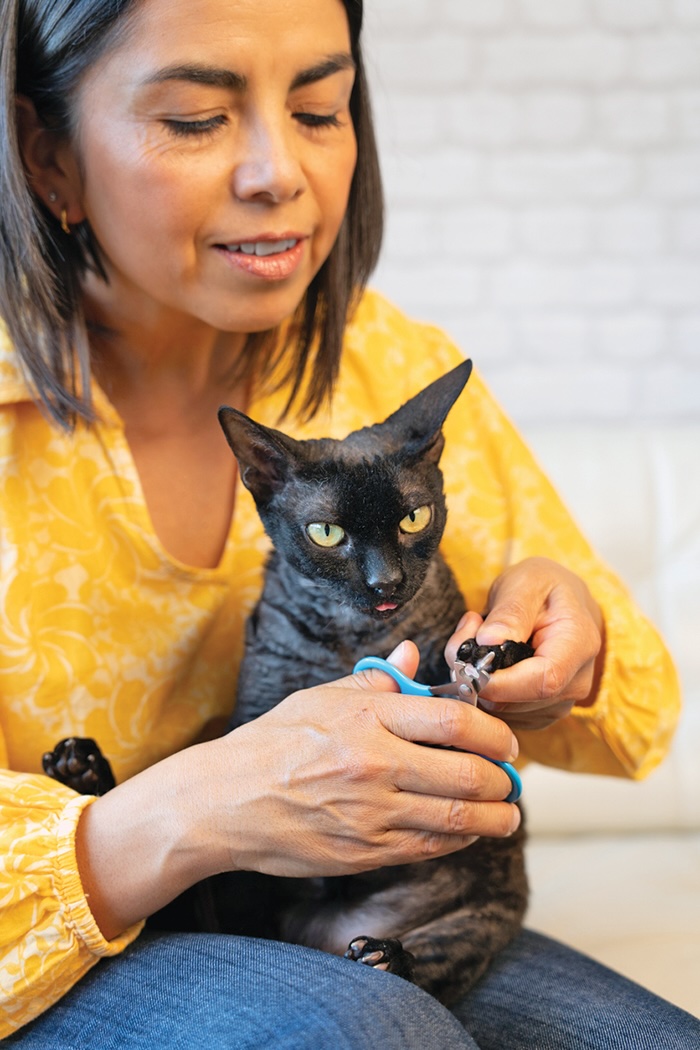
Whether you have an older cat whose claws are overgrown or are trying to save your furniture, claw trims are something you will likely be able to do yourself at home.
Where to Cut
Cat claws are almost always white or cream-colored, with a dramatic curve and taper to the sharp point. The thick base of the claw where it attaches to the toe will have a pinkish hue from the blood vessels and nerves inside that portion of the claw. Don’t cut there! The narrower portion that curves to the point will be totally white or cream and is the safe spot to clip.
Senior cats sometimes develop thick, brittle claws that do not taper. For these claws, you can usually safely clip half or a third of the way from the tip of the claw to start. Then brush away flaking layers of keratin and see how the remaining claw looks before trimming more.
Tip: Start Slow
If your cat is not accustomed to having her claws clipped, start gradually. Just trim a couple claws or one paw, then take a break so she can relax.
 Often the best time to trim claws is after a meal or when your cat is resting so that she is calm and happy. If your cat is really food motivated, you can even trim her nails while she eats a meal or snack.
You and your cat will need to figure out what positioning and restraint works best for you. Most cats prefer minimal restraint, but cuddly felines may be comfortable with more contact.
The easiest option is to hold your cat upside down in your lap like a baby. This gives you easy access to all four paws, and you can orient her for the best angle for your dominant hand. If your cat is not used to being held in this way, start by getting her used to that. Hold her for a few seconds, then release, praise, and reward. Repeat until she is relaxed and calm (may take several sessions).
Many cats prefer to remain in a normal cat position. For example, if your cat sprawls on her side on the couch, you can trim her claws that way.
You can gently restrain your cat in a loaf position on a table or other furniture by bracing her body on either side with your forearms and using your torso to help keep her in place. You do not need to hold tightly—just block her from squirming away. Rotate her body as needed to gently pull one paw out at a time to trim, keeping her in a normal upright position.
For wiggly cats, a towel burrito wrap often works well. Lay a bath towel out flat, and place your cat in the middle. Wrap one side and then the other around your cat, swaddling her like a baby. To trim her claws, wriggle each paw free one at a time before returning it to the burrito. This may be easiest with two people: one to hold the wrapped cat, and one to locate each paw and trim the claws.
Difficult Cats
Grumpy cats may require two people to trim claws safely. One person will be in charge of holding the cat, while the other gets the trimming done.
Always remember that your cat has very sharp teeth and maintain control of her head. Wrapping in a towel as described above is a great way to restrain slashing claws, but will not stop a bite.
You can limit your cat’s range of motion by gently but firmly holding either side of her skull (keep fingers clear of her mouth). For added safety, wear thick leather gloves.
Whenever possible, it is well worth the effort of gradually getting your cat accustomed to the various pieces of a claw trim. You can work on this just a little bit each day to keep everyone’s stress level low and make it part of her normal routine. Break the whole task into small pieces, and repeat each step for several days:
Lay a towel flat and place your cat on it, then let her go.
Place your cat on the towel, fold one edge over her, then let her go.
Fold both edges of the towel over her before releasing.
Do a snug wrap, then immediately unwrap and release.
Maintain the snug wrap for 10 seconds, then release.
Build up to a couple minutes held in the wrap.
Wrap your cat, hold her head on either side briefly, and immediately release.
Build up the time of holding her head. When she’s relaxed you can absolutely stroke her with your fingertips.
Work on paw handling separately if possible. You can incorporate this with meals or scheduled treat times so your cat is motivated to tolerate you and gets an immediate reward. Use these steps to break it down:
Run your hand down the side of your cat’s leg before giving the treat.
Loosely grasp the leg and run your hand down before giving the treat.
Run your hand down the leg, pausing briefly at the paw before releasing and rewarding.
Build up to holding the paw several seconds.
Flex your cat’s paw to expose a claw or two, then release and reward.
Handle two paws before rewarding.
Take your time! The early steps may feel trivial, but they are an easy way to to make handling nail trims a positive experience. Use whatever rewards are most meaningful for your cat, like bits of meat, toys, ear rubs, catnip, etc.
Ingrown Claws
If your cat has ingrown claws that have pierced the paws, schedule a veterinary appointment. Getting those claws trimmed back will likely hurt, and your cat may need sedation. Plus, the veterinarian can clean the wounds with antiseptic and prescribe antibiotics if needed. Work on regular nail trims at home once her paws have healed.
Any time you are working on something new with your cat, try to wrap up the session before she loses patience so you end on a good note. You will make progress faster if you do frequent mini sessions versus wrestling her for a full nail trim once a month.