We all know that being overweight predisposes our cats to many health problems. But transforming your chubby couch potato into a sleek feline takes time and persistence. Set yourself and your cat up for success by choosing an appropriate food, measuring meals, and increasing her activity.
Is My Cat Fat?
If your cat’s shape is more like a fluffy basketball than a cheetah, she probably needs to lose some weight. Body-condition score (BCS) charts are freely available online to help you get an idea of where your cat falls on the spectrum of fitness. You will be looking at your cat’s profile from the side and at her waistline from above to determine her BCS.
We strongly recommend scheduling a veterinary exam before embarking on a weight-loss journey with your cat. Your veterinarian can confirm or refine your cat’s BCS and help you determine your cat’s ideal weight. If your cat is obese, you need a series of gradual weight-loss goals rather than aiming for your cat’s ideal weight right from the start.
Gradual weight loss is critical for cats. Losing a lot of weight rapidly can cause hepatic lipidosis, where the breakdown of fat clogs up the liver and leads to liver failure. Hepatic lipidosis can be fatal.
Food
For many cats, a prescription weight-loss food is the best option. These diets are designed to be filling and have all the nutrients that your cat needs while still being low-calorie. Prescription foods are often more expensive than foods you can find at the grocery or pet store, but this is because these foods have undergone extensive testing to make sure they provide what your cat needs.

Over-the-counter weight-loss or weight-management foods may be appropriate for some cats. Check the calories carefully though, as sometimes these foods are just as calorie-dense as foods that are not labeled for weight control.
The nutritional breakdown of the food matters, too. For most cats, choosing a food that is higher in protein and lower in fats and carbohydrates is the best way to promote weight loss. Eating food high in protein promotes the buildup of muscle, plus protein has fewer calories than fat.
Note: This is a general rule and may not be the right fit for all cats. If your cat has kidney disease, a high-protein diet may put unnecessary strain on her kidneys. And some cats may experience soft stools and stomach upset when switched to a diet with lower carbohydrate content and higher protein.
Always make diet changes slowly, introducing the new food bit by bit over at least a week. This is especially important if the new diet that you are switching your cat to has a very different nutritional makeup from the food she has been eating.
Measured Meals
One of the things your veterinarian will go over with you is how many calories your cat should be eating each day to achieve her target weight. Once you have that number, you will need to figure out how much of your chosen food your cat can eat each day. Tip: Veterinary staff can do these calculations for you.
Split your cat’s daily calorie allotment into small meals throughout the day. This will help to keep your kitty satisfied and less demanding for food later in the evening. For example, if your cat is supposed to eat 200 calories a day, feed 50 calories in the morning, 50 calories midday, 50 calories at dinner time, and 50 calories right before bed. You can arrange your cat’s meal schedule to fit both of your routines.
If your cat is your only pet, you can break her daily calories into even smaller portions and set up a scavenger hunt throughout your house. This strategy spreads out her calorie intake and encourages her to exercise as she searches the house for her next snack.
Exercise
In addition to decreasing the calories going into your cat’s mouth, effective weight loss requires increasing the calories your cat expends. Encouraging a cat to exercise requires creativity and experimentation. Here are some things to try with your cat.
Scavenger hunts are a good option if your cat is your only pet. You can break her daily calorie ration into many small servings and hide them throughout the house for your cat to find. Use food stashes to encourage your cat to go up and down stairs, climb cat trees, and duck under furniture. This usually does not work with multiple pets, as you can’t control who eats what.
Puzzle toys are toys that your cat must manipulate to access the food. These are great options for many chunky cats because we know they like food! Puzzle toys can range from a simple ball with a hole that your cat rolls around to get food to fall out to a complex series of levers and knobs that need to be adjusted to reveal the food. Start with something easy so your cat has a good experience, then build the difficulty over time.
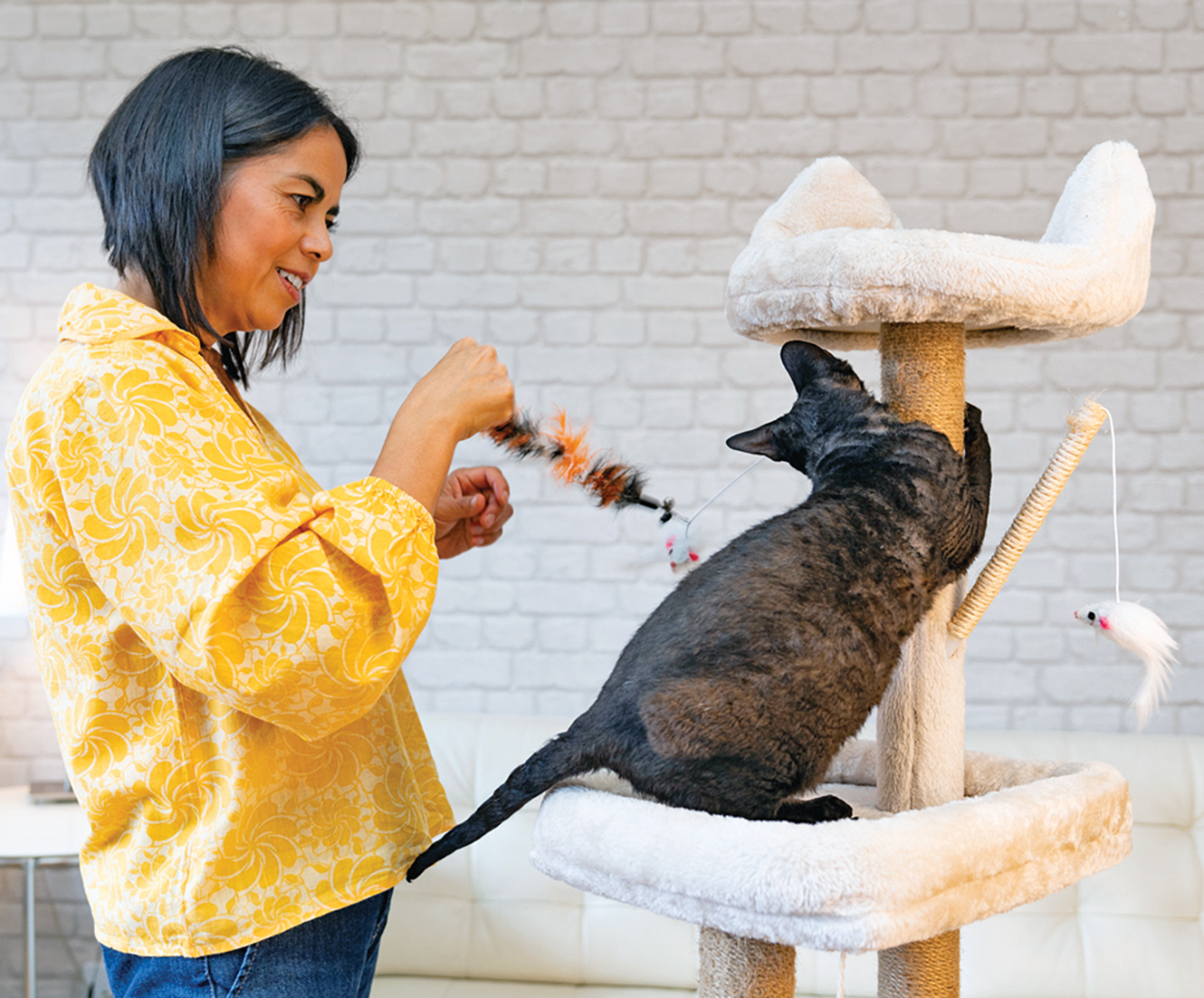
Schedule playtime into your daily routine. Even five minutes a day is a start. You canincrease duration as your cat gets more stamina. Try a variety of toys to figure out your cat’s play style. Some cats love feathered wands, while others prefer jingly balls. Plastic springs and catnip toys are two other popular options, and some cats love a good old, crumpled piece of paper.
Keep play sessions short at first and try to always end playtime while your cat is still wanting more.
Teach your cat to wear a harness and walk on a leash. Start by getting her used to wearing the harness for short periods in the house. Then attach the leash and follow her around the house, rewarding with treats periodically. As she gets comfortable with that, you can use treat drops every few feet to teach her to follow you as you walk. Once she has the hang of walking with you inside, you can start introducing her to outside walks.
Toss kibble or treats in the house for your cat to chase. Hallways and large rooms are perfect for this. You can also put obstacles in your cat’s path for her to jump.

Teach your cat tricks. Most cats are smart, and you can use part of her daily rations as rewards during training time. Tricks that cats can easily master with some patience and positive reinforcement include shake, sit, spin, and coming when called.