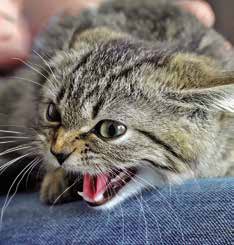
Few things are more terrifying than a cat with his Violence Mode engaged. Eighteen or more sharp claws, 30 sharp teeth, and a flexible body make our feline friends incredibly dangerous when they want to be. Handling a cat that is angry or upset must be done carefully and calmly.
“My first response is to NOT handle a frightened or angry cat,” says Pamela J. Perry, DVM, PhD, DACVB, a graduate of Cornell University’s College of Veterinary Medicine. “If possible, give the cat time and space to calm down.”
Reading Body Language
Cats use their body language to tell us how they feel. A happy, relaxed cat has loose body language and moves with easy, fluid movements. Their gaze is inquisitive, and their tail lolls slowly.
An upset cat paints a different picture. These cats are usually tense with eyes wide and pupils dilated. A fearful cat will huddle and make themselves as small as possible, curling away from you and running or hiding if possible. An angry cat will puff up to look as large as possible and will have whiskers forward and ears pinned back. The cat may also growl or hiss.
Both angry and fearful cats may lash out with their claws or try to bite. Fearful cats generally don’t want to hurt you but will do so if they feel trapped and don’t have any other option.
Calming Down
Whenever possible, allow a distressed cat to calm down before attempting to handle them. “Once a cat is fully aroused, it can take up to 30 minutes or more for her to return to baseline,” says Dr. Perry.
If you just caught a neighborhood stray in a trap, and he is panicking, cover the trap and leave him be for a while. If you just broke up a scuffle between your cats and one is hissing and spitting, leave the room rather than trying to pet the cat to calm him down.
Things to watch for as your cat calms down include slower breathing patterns, no open-mouth panting, eyes no longer wide, and body and ears in a neutral position. These signs all indicate that the cat is in a lower state of arousal and safer to approach and handle.
Tips for Success
“If you must handle the cat, stay calm and go slowly,” says Dr. Perry. You might be forced to handle an angry or frightened cat if they are in a dangerous situation and must be moved as quickly as possible, or if they have a severe injury and require immediate veterinary care. Veterinary visits themselves can result in a stressed cat, but we’ll get into that later.
Focus on achieving your goal as quickly as possible to limit further distress for the cat while also preventing bites, scratches, or other injuries. Plan how you will approach the cat, what tools you have available, and where you need to move them before taking action.
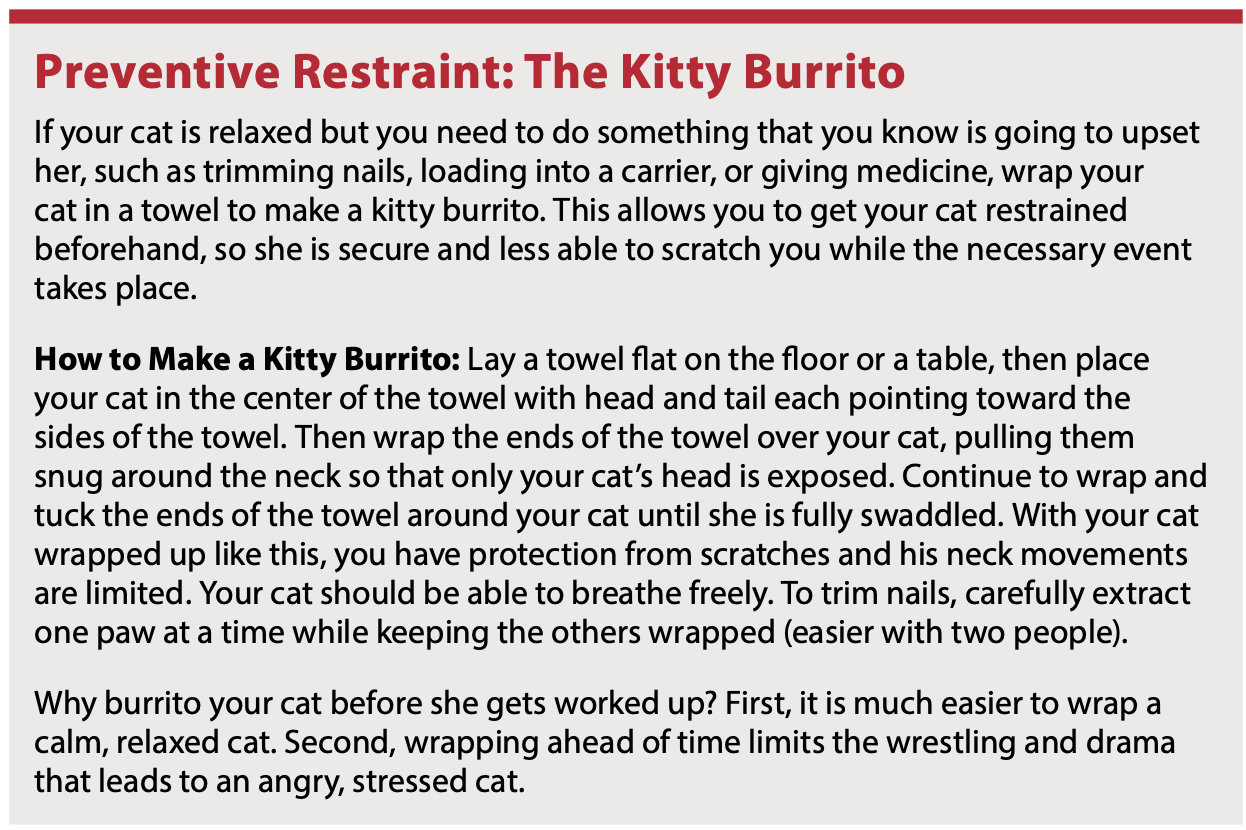
Use protective gear such as thick leather gloves and towels (see “Preventive Restraint: The Kitty Burrito”). The leather gloves will protect your hands and arms against scratches, but often will not fully protect against a hard, intentional bite. Towels provide some protection from cat claws and are great for limiting the cat’s view so they feel hidden while also restricting leg movement.
To pick up an upset cat, toss a thick towel over him and then quickly scoop the cat up, wrapping him inside the towel. Try to locate the cat’s head and hold gently but firmly behind the skull with your gloved hands. This will limit your cat’s ability to turn his head quickly and bite. Just be sure not to squeeze.
Top-opening, hard-sided carriers provide the easiest access for feisty cats. You can gently place your wrapped cat inside the carrier via the top door, then close it. The cat will be able to disentangle themselves from the towel within a few minutes, and likely will choose to burrow back under it to hide.
No carrier handy? A pillowcase can work as temporary confinement to transport your cat in an emergency. Just tuck your cat inside and then tie the top. And make a note to purchase a carrier to have as a safer, more secure transportation option in the future.
Even if your cat is acting out, stay calm. “Owners should never punish a cat, especially if he is frightened or aggressive, because it will make the situation worse and potentially cause future problems,” says Dr. Perry. Remember that your cat is biting and swatting because he is scared or confused, not as a personal insult to you.
Handling Vet Visits and Travel
If travel and/or veterinary exams are stressful for your cat, ask about a medication to calm your cat down ahead of time. Gabapentin is often used for this purpose. It comes in both liquid and pill forms and helps to calm your cat and keep the cat that way. Ideally, gabapentin should be given at least an hour before travel so that it can kick in before anything potentially scary happens, including loading your cat into a carrier.
At the clinic, let the staff take the lead. “Owners should refrain from restraining their cat at the vet clinic because of the risk of injury,” says Dr. Perry.
Your cat does not understand that vaccines, blood draws, and looking into their ears with a cone and light are all done for their benefit and may react in surprising ways if he gets scared. Veterinary personnel are trained to restrain cats in a variety of ways to minimize stress to the cats while also keeping all humans safe.
“However, the owner’s presence is often a source of comfort and security, so speaking to the cat in a calm, soothing voice can help ease the cat’s fear,” says Dr. Perry. “Tasty treats also can be offered if the cat is calm enough to eat the treats.”
When possible, look for Fear-Free Certified veterinary professionals. These veterinary personnel have undergone additional training to learn the best ways to provide care for your cat in the kindest way possible. But don’t be alarmed if there aren’t any Fear-Free Certified practices in your area. Watch how the staff handle and interact with pets and you will see how much they enjoy and appreciate the animals they work with.
Considerations for Feral Cats
Handling feral cats comes with additional challenges and concerns. While your pet cats may still lash out when stressed, they do have a relationship with you and a history of positive interactions. This is not true for feral cats. Strays also have an unknown vaccination history and may be carrying diseases that are contagious to humans, such as rabies. Avoid touching an unknown ca2t directly if possible.
Live traps are often the best and safest way to confine a feral cat and transport them for veterinary care. Leave the trap propped open with food inside for several days so that the cat can explore it and get used to it.
When the trap is set “for real” and captures the cat, the cat will be scared. This is normal, and understandable. Wild animals don’t like to be confined against their will.
You can cover the trap and move it to a quiet location where you know the cat will be safe while they calm down a bit. Keep in mind that the cat may urinate or defecate as a defense mechanism. Once the cat’s breathing has slowed, you can transport the cage to your destination.
Live traps aren’t exactly luxury accommodations, but they keep the cat safely contained so you can move them without getting bitten or scratched. And even basic veterinary care such as vaccinations and giving a dewormer will improve the cat’s health and chances of survival. You can make the experience a little bit less stressful for the feral cat by covering the trap with a blanket or towel, spraying artificial pheromones, and keeping other pets away.
“My first response is to NOT handle a frightened or angry cat,” says Dr. Pamela Perry. “If possible, give the cat time and space to calm down.”