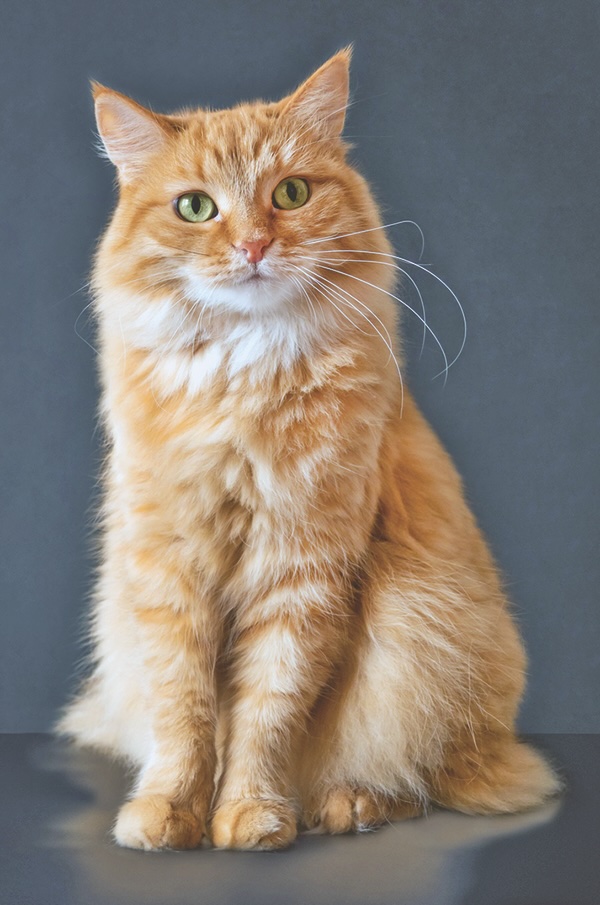
Researchers have been digging into why some cats have orange coats for decades, according to a story in Science. They’re questioning why most orange cats are males and calico and tortoiseshell cats are usually female. Of course, we know it’s genetics, but now two studies have isolated the chromosome.
The genes for orange and black hair are both associated with the X chromosome. Since females have two X chromosomes, they can be black and orange in color. Males have one X chromosome, so they are one or the other color, not a mix, unless they have an abnormal genotype.
Researchers in Japan and at Stanford University were searching for the “orange mutation.” Both found it at about the same time and will be publishing together. From the preprint, it appears that the Arhgap36 gene on the X chromosome is involved. This gene causes an excess of RNA in melanocytes (cells associated with pigment production) in orange cats and cats with any orange coloration.
The Stanford University researchers wrote: “The Sex-linked orange mutation in domestic cats causes variegated patches of reddish/yellow hair and is a defining signature of random X-inactivation in female tortoiseshell and calico cats. Unlike the situation for most coat color genes, there is no apparent homolog for Sex-linked orange in other mammals.”
What makes it unusual is that the mutation leading to orange fur involves a deletion in the genetic code that makes this gene more active. Deletions generally make a gene less active. Cats continue to be unique in many ways. Luckily, this mutation appears to primarily influence melanocytes and not other vital cells in development.
Kaelin, C.B., et al. “Molecular and genetic characterization of sex-linked orange coat color in the domestic cat.” bioRxiv 2024.11.21.624608; doi: https://doi.org/10.1101/2024.11.21.624608