Anyone who works with a feline shelter is very aware of three potentially deadly feline viruses: feline leukemia virus (FeLV), feline immunodeficiency virus (FIV), and feline infectious peritonitis (FIP). While we have an effective vaccine to protect our cats from FeLV, it is still commonly diagnosed in cats. FIV, while usually carrying a much more favorable prognosis than FeLV, can still be a significant cause of disease in cats.
With respect to FIP, while there is no doubt that recently developed safe and effective treatment options represent a paradigm shift in veterinary medicine, infected cats can still become quite ill and may ultimately succumb to their infections.
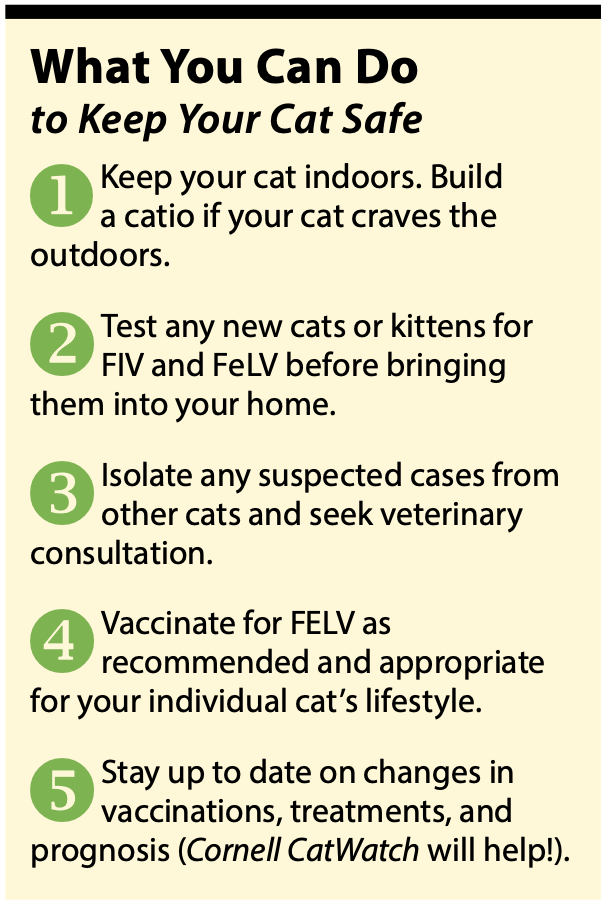
For these reasons, if your cat runs outside, if you adopt cats from shelters, or if you provide care to a feral clowder of cats, it’s important to stay up to date on these viruses.
Feline Leukemia Virus
FeLV used to run rampant in cat populations. Thankfully, improved testing, care, and effective vaccines have helped to reduce the occurrence and fatality rate of this virus.
FeLV is a retrovirus that does not survive for long in the environment, but it can be incorporated into your cat’s genome, making it difficult to eradicate. Infected cats can be long-term shedders. The virus is shed in the saliva, urine, feces, and milk of progressively infected cats (see below) and is easily transmitted to susceptible cats via mutual grooming and sharing of food and water bowls and litter boxes.
When an unvaccinated cat is exposed to the FeLV, there are three potential outcomes:
- An “abortive” infection in which the cat mounts an effective immune response and eliminates the virus. Between 20 and 30% of FeLV infections in cats are abortive.
- A “regressive” infection, in which cats manage to avoid any clinical illness but don’t eliminate all the virus from their bone marrow. Regressively infected cats are not generally infective to other cats unless they experience a “reactivation” of the latent virus that remains in their bone marrow (usually due to some sort of stress). Cats with “reactivated” regressive infections may show clinical signs of illness and can shed the virus and infect other cats. Studies show 30% to 40% of susceptible cats exposed to FeLV end up with regressive infections.
- A “progressive” infection, with which the virus is circulating in the blood, signs of illness are observed, and virus is shed in the body secretions mentioned above. Progressively infected cats are sources of infection for other cats.
FeLV Clinical Illness
Cats progressively infected with FeLV can develop a range of diseases, including the development of cancers (usually lymphoma, the most common cancer of cats), immunosuppression, and anemia.
Weight loss, anorexia, and enlarged lymph nodes are frequently seen, but pale membranes, fever, resistant diarrhea, and infections of the skin, respiratory tract, bladder, and mouth are possible. There is, unfortunately, no cure for FeLV, and treatment is supportive and geared toward minimizing symptoms. The median survival time of cats diagnosed with progressive FeLV infections is approximately five years.
The diagnosis of FeLV usually starts with screening blood tests, such as an enzyme-linked immunosorbent assay test (ELISA) that detects circulating virus in the bloodstream. Importantly, this test can return false negative or false positive results, as a cat that tests negative may be too early in the infectious process to have the circulating virus that the ELISA detects in its bloodstream, and the immune system of a cat that tests positive may ultimately eliminate the virus.
With healthy cats that test positive, it is best to isolate them and then retest 6 weeks later. A polymerase chain reaction (PCR) test (a sensitive test that tests for the presence of viral genetic material) can be used to verify the results of an ELISA test and can help determine whether a cat has a regressive FeLV infection.
You should vaccinate your cat against FeLV if he/she has not been diagnosed with an FeLV infection if she has any potential exposure to FeLV-infected cats (i.e., will be let outside). All cats should be tested for FeLV before vaccination protocols start, and there is no value in vaccinating a cat that is already infected.
The FeLV vaccine is not considered a core vaccine, as indoor-only cats living in a stable population of FeLV negative cats should be safe from exposure, but at least the initial course of FeLV vaccines should be given to all kittens. Discuss an individual vaccination program for your cat with your veterinarian.
Feline Immunodeficiency Virus
FIV attacks cats’ immune systems, making them susceptible to a variety of infectious diseases and, in some cases, cancers.
A screening ELISA test looks for antibodies to the FIV virus, suggesting prior exposure to the virus. False negative results can occur if an infected cat is early on in her infection and has yet to produce adequate antibodies to show up on the test. False positives can occur in young kittens that received FIV antibodies from their mothers while nursing (called maternal antibodies) and in vaccinated cats (importantly, there is no approved vaccine in the United States, but some are available in other countries).
Young kittens that test positive for FIV should be retested at 4 months of age (to allow confounding maternal antibodies to leave their systems), and a follow up PCR test is recommended for any cat who is outwardly healthy but tests positive.
FIV Clinical Illness
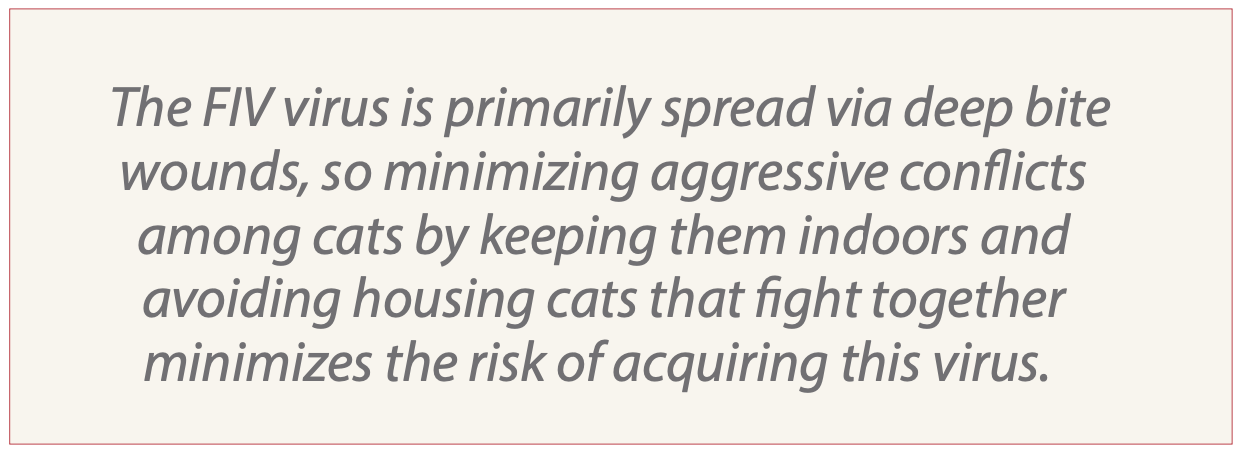
FIV causes immunosuppression, making infected cats more susceptible to infectious diseases and cancers. The FIV virus is primarily spread via deep bite wounds, so minimizing aggressive conflicts among cats by keeping them indoors and avoiding housing cats that fight together minimizes the risk of acquiring this virus.
Unlike with FeLV, infected cats can live with uninfected cats without a high risk of transmission if they do not fight. Importantly, recent studies suggest that FIV-infected cats may have similar lifespans to uninfected cats as long as effective preventive and proactive veterinary care is provided.
Unfortunately, there is no safe and effective treatment for FIV, and any sign of illness in infected cats must be addressed promptly. FIV-positive cats should not eat raw food to avoid exposure to bacteria in the diet (we believe this is true for all cats!). While FIV is sometimes referred to as “feline AIDS,” it is not transmissible to humans.
Feline Infectious Peritonitis
FIP is caused by mutations of a ubiquitous feline coronavirus that is distinct from the virus associated with human COVID-19. Most versions of this are mild enteric viruses (called FeCV) that may cause mild gastrointestinal or respiratory illness from which most infected cats spontaneously recover with no treatment.
Sadly, between 5% and 10% of cats infected with FeCV, the virus undergoes mutations to the FIP form of the virus. In these cases, the virus infects white blood cells and manages to spread throughout the cat’s body. The infected cells often collect in the abdomen, kidneys, or brain and cause a severe inflammatory reaction that we know as FIP.
FIP Clinical Illness
Once the FIP version of the virus is present, there are two primary forms of illness. Both forms may initially show nonspecific symptoms such as fever, depression, and anorexia with corresponding weight loss. They then most commonly progress to either a “wet form” or the “dry form” of the disease, although some cases may change forms during their progression.
The non-effusive or dry form tends to develop more slowly and usually attacks a cat’s neurological system, causing uncoordinated gait, problems with balance, and/or seizures.
The effusive form usually comes on faster and causes fluid accumulation in the chest and the abdomen. In the chest, the fluid can interfere with normal breathing. With the accumulation of abdominal fluid, cats develop a “pot belly” appearance and gastrointestinal signs.
The FeCV form of the coronavirus is easily spread through feces and saliva but also through shared food and water bowls. Whether or not an FeCV infection will progress to FIP is likely dependent upon the genetics of the virus, the individual cat, and upon other environmental factors, including stress. Until recently, a diagnosis of FIP was a death sentence.
Over the past several years, safe and effective antiviral drugs, most notably GS-441524, have been developed, turning a previously almost routinely fatal infection into a treatable disease of cats.
While not currently approved in the U.S., the FDA has stated that it does not intend to enforce approval regulations related to GS-441524 use to treat FIP in cats, This clears the way for the development of a reliable source of an oral formulation of the drug (through Stokes Pharmacy) for cats diagnosed with FIP. Importantly, a veterinarian must prescribe GS-441524 for a specific individual cat to obtain it via these legal routes in the U.S.
The treatment (which is effective in between 77% and 85% of all cases) is available as a tuna-flavored tablet or a liquid suspension and should be given for 12 weeks unless otherwise advised by a veterinarian, although many cats show improvement in just two to five days.