Q: My 8-year-old cat, Jennie, has regurgitated regularly since I adopted her at 1 year of age. Can you provide some insight into what might be causing Jennie’s problem?
A: Thanks for getting in touch, and while regurgitation is not as common in cats as vomiting is, it is important to recognize the difference so that appropriate steps can be taken to address any causative conditions.
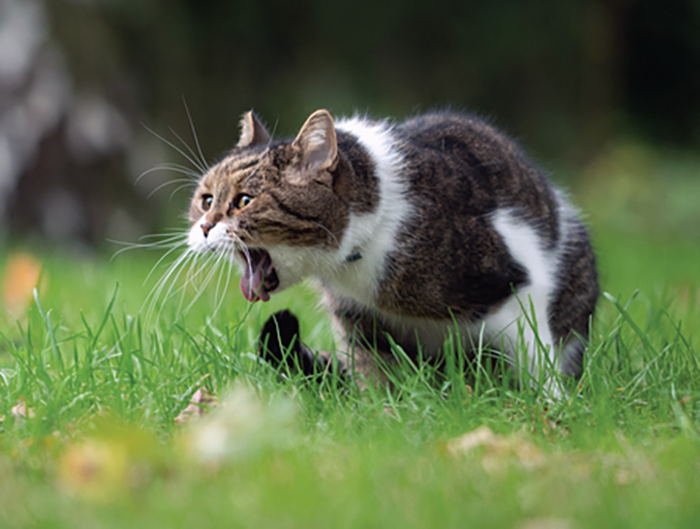
Unlike vomiting, which is an active process that involves contraction of the stomach and abdominal muscles resulting in forceful ejection of stomach contents through the esophagus and oral cavity, regurgitation is a more passive process in that no contraction of the stomach and abdomen is involved. The contents of the esophagus literally “fall out” of the mouth.
Regurgitation most commonly occurs immediately after eating or drinking, and the ingesta (contents of the digestive tract) that is expelled is not digested. If a cat regurgitates less than once monthly, particularly if this occurs after eating/drinking quickly and/or overeating, there is likely no need to be concerned. If it is observed more frequently and/or if it is not associated with eating or drinking, though, consultation with a veterinarian is warranted.
Several other conditions can lead to regurgitation in cats. Diseases of the esophagus, including congenital or acquired strictures (narrowings), decreased esophageal motility secondary to muscular/neurologic disease, cancer, parasites, hernias, and foreign bodies may also result in regurgitation in cats. Although not a common cause of feline regurgitation, allergies to food can contribute to a cat’s regurgitation.
Rarely, congenital malformations of the vessels surrounding the esophagus impinge upon it, resulting in a mechanical obstruction to food passing normally through the esophagus (called a vascular-ring anomaly), with subsequent regurgitation.
Determining the cause usually involves bloodwork and imaging studies. In some cases, cats may be given a dye (barium) to swallow prior to radiographs so that the dye can be followed through the GI tract via serial radiography to rule out GI obstruction. Endoscopy (passage of a flexible camera through the oral cavity and down the GI tract) may be required in some cases.
The treatment of regurgitation in cats depends upon its cause. This may involve simply modifying how fast a cat eats/drinks by feeding smaller meals, limiting access to large amounts of water, and/or using food bowls designed to slow down the rate of food ingestion. Elevating food and water bowls can allow gravity to help move food and water through the esophagus, and warming food may also be helpful. Esophageal foreign bodies can often be removed via endoscopy or surgery, and tumors, strictures, hernias, and vascular ring anomalies may be amenable to surgical repair/removal. In some cases, dietary modification may be helpful in cases suspected of being mediated by food allergies.
I hope this helps. Please consult with your vet if Jennie is regurgitating more than once monthly and/or when she has not recently eaten/drank.