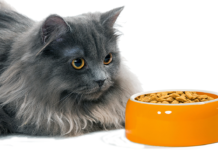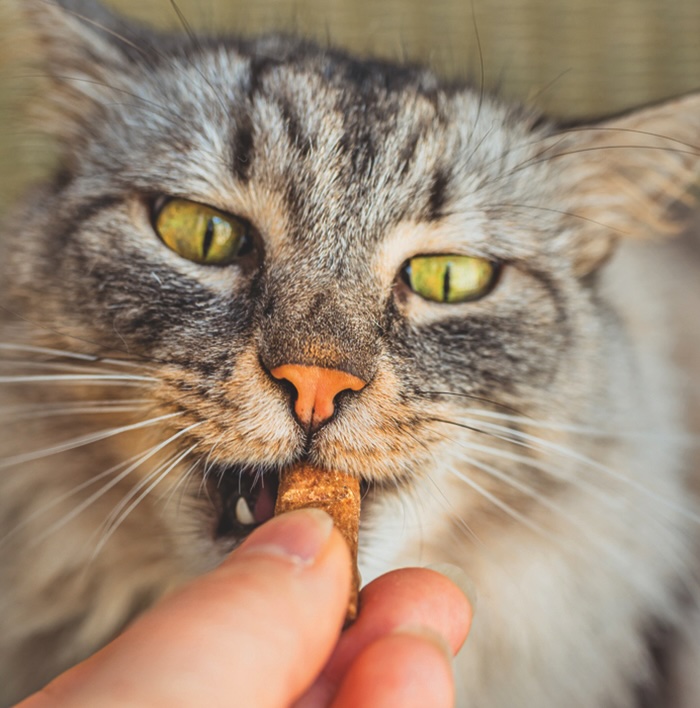
It’s fun to give your cat treats! We all enjoy a special little something occasionally, and it is an enjoyable bonding activity between cat and human. The trick is to incorporate soups, sauces, and other treats into your cat’s routine in such a way that they do not interfere with proper nutrition or weight management.
Gold Standard
The ideal balance is that your cat should get at least 90% of their daily calories in the form of a complete and balanced food, so 10% of their calories from treats.
Unlike foods designed to be fed as meals, treats are generally not nutritionally complete. This does not mean that treats are bad for your cat or that they are made with junk or filler ingredients. It just means that cat treat ingredients are focused on tastiness and enjoyment, without considering things like vitamins, minerals, and amino acids that your cat needs for optimal health.
The average 10-pound pet cat needs about 261 calories a day. This means that at most 26 calories a day can come from treats, while 235 need to come from a balanced diet. The Pet Nutrition Alliance has a fabulous online calorie calculator for cats that you can use to determine your cat’s caloric needs, and it even breaks down the amount of calories that can come from treats: https://petnutritionalliance.org/resources/calorie-calculator?type=cats
To put these numbers into practice, check out the nutrition information on the labels for your cat’s food and treats. If you feed dry food, the calories are usually listed per cup. If you feed wet food, the calories are usually listed per can or packet. Remember that your cat’s daily calories will also need to be divided by the number of meals you give. A 10-lb. cat will usually need about 118 calories per meal if eating twice a day.
Treat calorie count varies widely by the treat but will also be listed on packaging. One Greenies Smartbite is 1.3 calories, and an entire tube of Churu paste is 6 calories. On the other hand, an Applaws tuna loin clocks in at 21 calories. So, our 10-lb. cat could have 20 Greenies Smartbites crunchies in a day or four tubes of Churu but should probably stick to just one Applaws tuna loin a day.
Weight Management
For our chunky cats, calorie counting is important. Your veterinary team can help you with the math to determine how much your cat should be eating for meals and can give you a daily treat allowance.
Cutting back on treats can be hard! To make the adjustment a little easier on both you and your cat, look for treats that are similar in volume but have lower calories. For example, if your cat is used to getting three pouches a day of a treat that has 8 calories per pouch, switch to one that only has 5 calories per pouch. If your cat is currently stealing Mini Milk Bones (5 calories each) from your dog, switch her over to a crunchy cat treat that is only 1 or 2 calories apiece. And don’t forget to count out the pieces at the start of the day so you know what you are working with.
Another option is to use their regular food in lieu of treats. So, if your cat has switched to a prescription weight loss diet, maybe feed the canned food formula at meals but have some kibbles on hand to use as treats.
Training and Play
You can use your cat’s love of treats to encourage activity. Instead of just giving your cat a treat because they’re adorable, have your cat follow you across the room to “earn” it. Start teaching simple tricks like coming when called, shake, or sit. Solid treats can be rolled across the floor for your cat to chase.
Soups and Sauces to Ease Transitions
If your cat needs to change food due to a health issue or their previous diet being discontinued, you can use treats to help smooth over the transition. Add some of your cat’s favorite soup or sauce treat to their meals to make the new food taste familiar, then over time decrease the amount of treat added in.
Remember that you will still need to consider that maximum 10% treat calories a day when determining how much of a liquid treat you add to meals and how much you give separately.