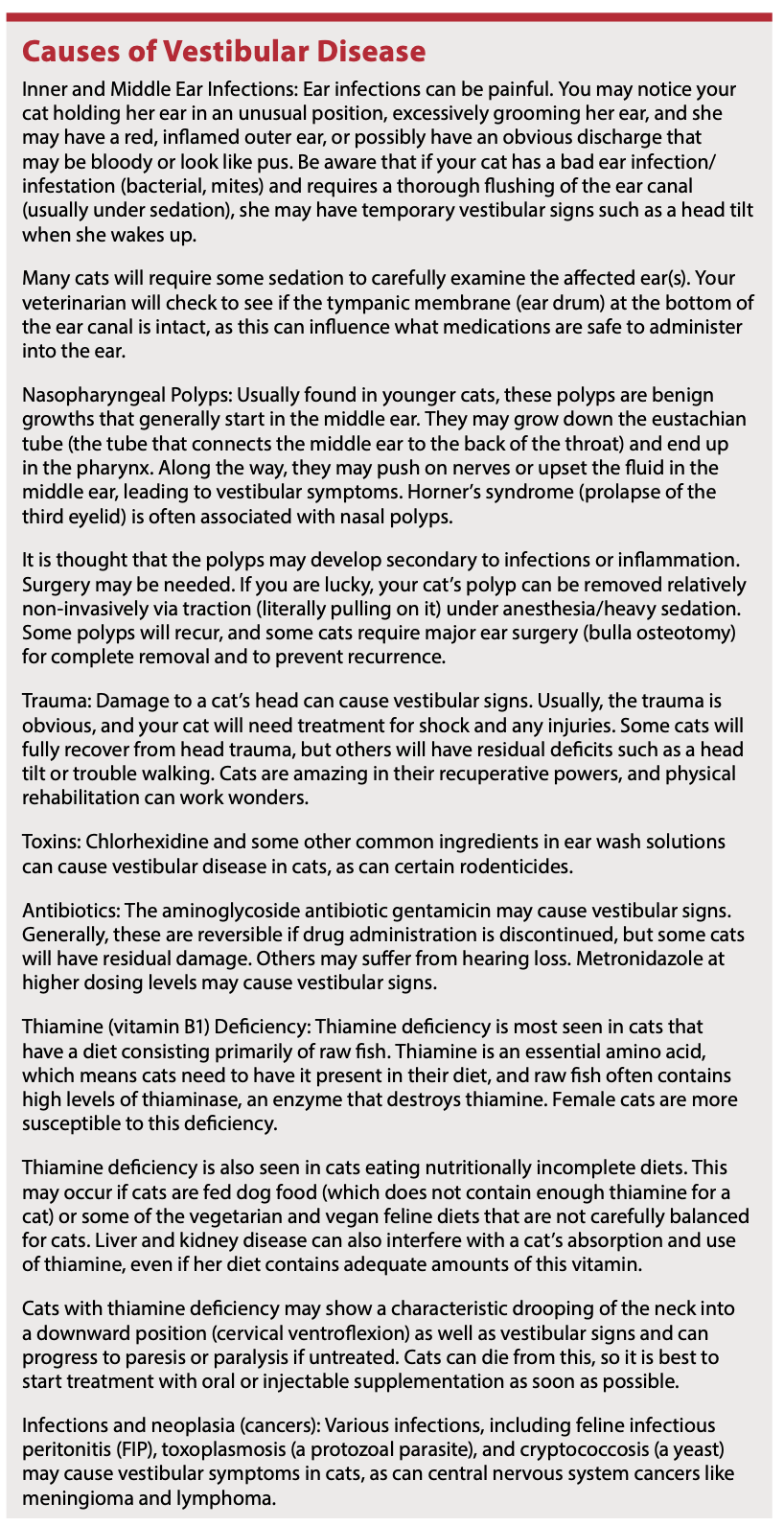
Cats with a vestibular problem may have a head tilt, walk in an uncoordinated fashion, lean or roll to one side, circle, and/or experience nystagmus, an oscillating, rhythmic motion of the eyeballs.
These signs may be mild at first and then progress over a period of days.
Causes of Vestibular Syndrome
Unfortunately, most cases of feline vestibular syndrome are idiopathic, meaning that their cause is unknown. They can, however, be caused by other conditions, including cancer, polyps, ear infections, and trauma.
This condition can occur at any age and seems to occur most often in late summer. This has led to speculation that Cuterebra, a species of bot fly that lays its eggs near the burrows of rodents and rabbits, may be involved in many cases. When outdoor cats hunt in these areas, the eggs may become attached to them and hatch. The larvae can then be ingested when the cat grooms, accidentally inhaled, or can enter a cat through breaks in the skin.
Once inside a cat, the larvae move and settle in under the skin, where they incubate, leaving a small opening or breathing hole to the outside. Eventually, the larvae mature and exit the cat, falling to the ground where they pupate and ultimately mature into adult flies, completing the life cycle. How Cuterebra larvae may cause vestibular disease is unknown, but it is possible that larval migration through the tissues of the inner ear and/or the brain may contribute to this condition.
Diagnosing Causes of Vestibular
It’s important to talk with your veterinarian if your cat has a vestibular episode. Diagnosing vestibular problems in cats starts with a thorough physical and neurologic exam. A careful examination of the ears to rule out inner ear infection and nasopharyngeal polyps is also recommended, and some cats may need to be sedated for this. Radiographs (X-rays) of the head may be recommended to check the skull and middle and inner ear structures.
In some cases, more extensive imaging such as an MRI or CT scan may be recommended, and referral to a specialty veterinary facility will usually be required for these tests.
Treatment
Treatment for vestibular symptoms starts with supportive care. Maropitant citrate (Cerenia) helps reduce nausea and helps minimize nausea-induced vomiting. You may need to hand feed with feeding pastes and carefully syringe water or use subcutaneous fluids if your cat isn’t drinking. Most cats with mild cases of vestibular disease are back to eating and drinking within a day or two.
Because an affected cat’s mobility may be temporarily affected, you may need to make some management adjustments, such as improving access to her water and food bowls.
A low-sided litterbox will help her to get in and out. Make sure her bed is accessible. You might need to provide some nonslip ramps, add some nonskid rugs so she can get around her normal places in your home, block off unsafe areas like staircases, and not allow the cat outside unsupervised.
Slow Recovery
Once signs stabilize, healing can start, but recovery may take time. Most cats take weeks to months to gradually return to normal. Some cats will always retain a slight head tilt or an occasional off-balance step. Luckily, most cats adapt very well to minor vestibular changes.
If a cat has one of the more serious causes of vestibular disease, symptoms tend to progress rather than becoming static or improving.