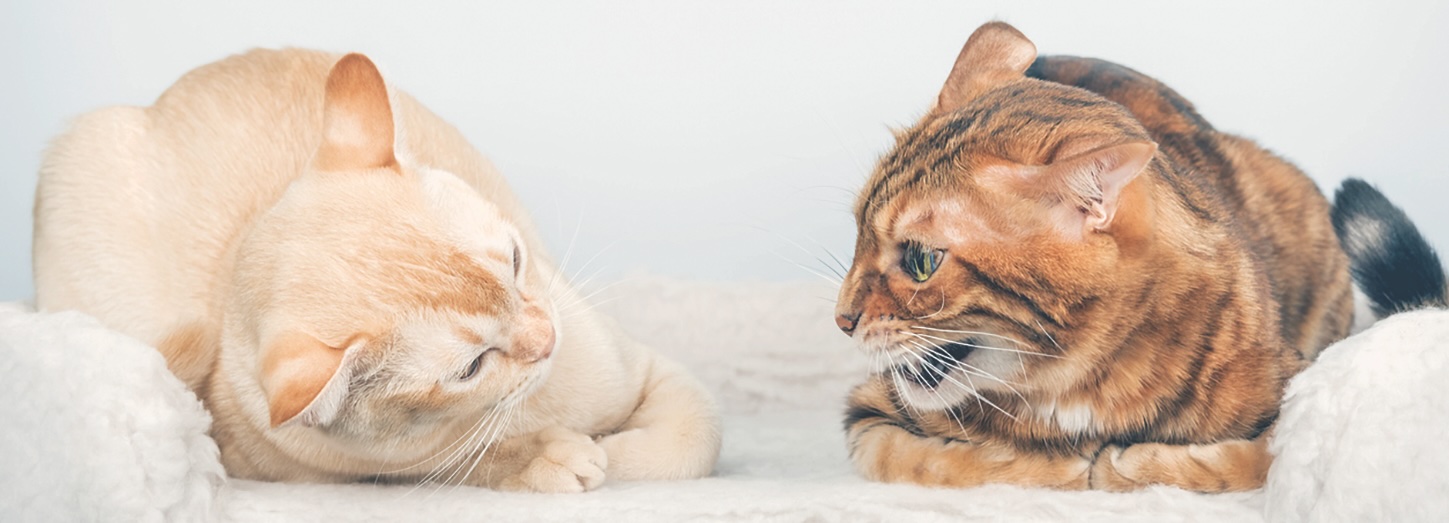
Since feline socialization is not broadly understood, the Feline Veterinary Medical Association (VMA) produced a comprehensive set of guidelines for identifying and managing feline tensions in multicat households.
“Some say that a single cat is a happy cat, but there certainly are some cats who are socially bonded and prefer to live together,” says Pamela Perry, DVM, a board-certified veterinary behaviorist at Cornell University’s College of Veterinary Medicine.
“The maximum number of cats per household depends on numerous factors, including the relationships between all cats as well as the distribution of resources throughout the home. Obviously, the higher the density of cats, the greater the likelihood of conflict,” says Dr. Perry.
If two kittens or adult cats were adopted together that have been living together, they are often bonded and are commonly happy together. While the most compatible of feline pairs is usually one male and one female (with neither one intact), that is not always the case.
Many cats will also form bonds with other pets. And, of course, many cats become attached to their people. Some cats actively interact with fellow members of the household, while others can best be described as co-existing.
Ways to Reduce Tension
If you’re adding a new cat to the family, it’s best to prevent any behavior problems from starting. Behavior problems are much easier to prevent than to fix.
The Feline VMA Guidelines stress five pillars that contribute to reduced tension among cats:
- Safe places for each cat to hide
- Multiple sources of food, water, and litterboxes
- Chance to play, including encouraging predatory behaviors, which may be solitary or in a group
- Plenty of human interactions, either as individuals or in a group
- An environment that provides stimulation for the cats’ senses
If you want a multicat household and are starting from scratch, adopt a bonded pair if possible. If you need to mix and match, see if you can do a foster situation that helps you choose a compatible set.
Once you choose compatible cats, arrange the environment. Dr. Perry says that one of the most useful techniques for avoiding problems is to provide essential resources for all cats but distribute them throughout the house. This method allows cats who do not get along to access resources without needing to encounter each other.
At the very least, each social group (as identified by affiliative behavior) should have separate resources in their respective territories within the home.
Multiple Resources
Resources should be set up so a cat can feel safe (while eating or using the litterbox, for example) and not worry about being ambushed. Even if this “attack” is in play, it can scare a timid cat away from these resources.
Certainly, one food bowl per cat is important, since feeding meals is better than free choice anyway. It can be important to track who is eating and how much. The rule of thumb is one litterbox per cat, but many experts recommend having a spare as well.

Providing human interaction, play, and a stimulating environment are important for a cat’s mental health, whether you have one or multiple cats. You don’t have to go to great expense. Cats will play with bottle caps, empty toilet paper rolls, a paper bag, or an empty box.
If you introduce a new cat to a cat who has been living alone in a home, go slowly. Make introductions with a door between the cats first, putting something with each cat’s smell in the other cat’s room. Then go to an open barrier like a baby gate.
Give both cats yummy treats when they are near each other to add positive feelings. The use of feline pheromone products may also help.
Pam Perry, DVM, is a board-certified veterinary behaviorist at Cornell University’s College of Veterinary Medicine.