You go to clean the litterbox and notice small, white wiggly things on your cat’s fresh stool. Or you are grooming your cat and find small, dried, rice-like objects around your cat’s anus. These observations suggest that your cat has tapeworms. The white things are freshly passed tapeworm segments containing packets of eggs, and the dried rice-looking things are dried segments.
While finding tapeworms is gross, luckily, they do not cause major health problems in most cases. Their presence means, however, that your cat likely has fleas or is hunting and eating infected rodent carriers.
Confirming the Diagnosis
How do you know your cat has tapeworms? First, check stools and the hair around your cat’s anus. Some cats will “scootch” their rear on the carpet as if they had an anal-gland problem. Rarely, a cat may throw up a tapeworm.
Unless a cat has an extremely heavy load of tapeworms, you won’t usually see signs like a nutritional drain and a poor haircoat. Intestinal obstructions due to large numbers of tapeworms are unusual but are more common with Taenia species of tapeworms.
Fecal checks may not turn up positive for tapeworms even if a cat is infected, as the egg segments are only passed periodically. You are more likely to notice the segments on your cat’s anus and/or in his stool than to diagnose infection via a routine fecal.
If you notice segments, bring a fecal sample with your cat to your veterinary clinic. Examining the segments can help to identify which type of tapeworms your cat has.
Types of Tapeworms
The most common tapeworm found in cats is Dipylidium caninum. This is the tapeworm associated with fleas. Larval tapeworms are ingested by fleas and can then be ingested by your cat when grooming.
If your cat has fleas or has been recently treated for fleas, be on the lookout for signs of tapeworms. It is not unreasonable to prophylactically dispense medication to treat tapeworms if your cat has had a flea infestation.
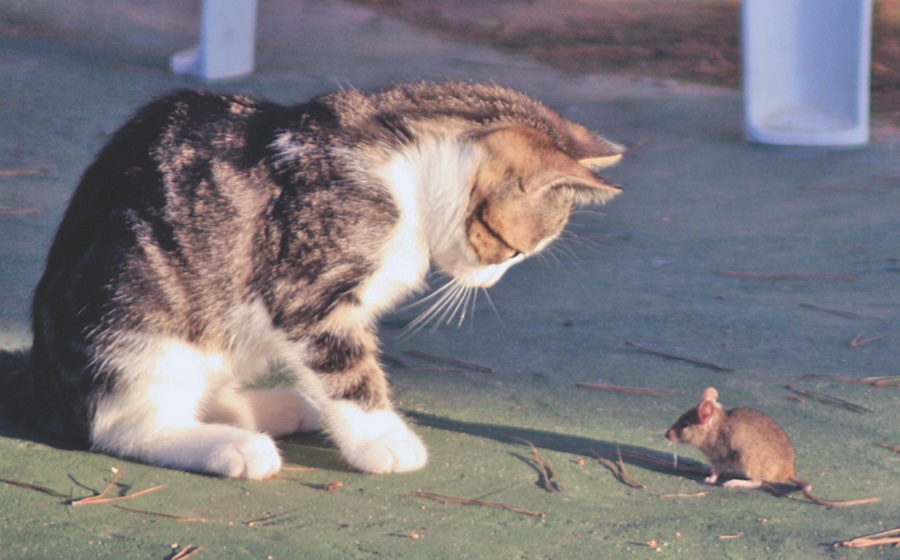
The second way cats can get tapeworms is by catching and eating rodents that are secondary hosts. The primary species of tapeworm here is Taenia taeniaeformis. Taenia eggs can survive in the environment for up to a year under ideal conditions. The adult tapeworms can live in your cat for close to three years.
Echinococcus multilocularis is a less common tapeworm of the cat. As with Taenia, this tapeworm infects cats who consume infected rodents. While not usually serious in cats, it does have zoonotic potential. If you live in an endemic area and have outdoor cats, your veterinarian may suggest periodic dewormings as a safety measure.
 Treatment
The Companion Animal Parasite Council recommends the deworming drug praziquantel formulated with emodepside to provide broad-spectrum internal parasite control. The medication may be a tablet, liquid, or even an injection. While one treatment often clears an infection, the odds of reinfection are high.
The difficult part for many owners is that, while medicating will kill off the tapeworms currently in your cat’s gastrointestinal tract, you need to cut off access to the intermediate hosts or the tapeworms will be back. That means war on fleas and/or preventing your cat from hunting.
Flea control requires full battle mode. You need to treat your cat, all other pets who might harbor fleas, and your home environment. Your best bet is to discuss the flea-control product with your veterinarian, and never use a dog flea product on a cat!
You might start with a bath to kill off fleas on your cat and remove flea eggs. You need to follow this with an oral or topical medication that will then kill any “future” fleas.
A thorough cleaning of the house and your cat’s bedding should also be done. Be sure to carefully contain the vacuum bag after doing the rugs and put it outside. You may need to utilize foggers, powders, or sprays to kill adult fleas and inhibit flea maturation in your home. In severe cases, consultation with a pest-control company may be warranted.
Outside, you want to make your yard less attractive to rodents that might bring more fleas around. Cleaning up brush piles, putting crushed stone near the house, and removing bushes can help.
Making your yard less attractive to rodents helps with the tapeworm species that use rodents as an intermediate host. The reality, however, is that if your cat goes outside and has an urge to hunt, she will periodically need to be treated for tapeworms.
Beyond ensuring that your cat is an indoor-only cat, which hopefully means no contact with rodents, you can put a bell on your cat’s collar to alert potential prey so they escape before being caught. Not surprisingly, many cats learn to move so stealthily that the bell remains silent.
Not having bird feeders cuts down on rodents, squirrels, and rabbits in your yard. You may feel that a well-fed domestic cat won’t feel the urge to hunt, but this is not usually true. Most cats are hard-wired to hunt even if they are not hungry.
Individual tapeworm segments may be seen in the feces of cats infested with tapeworms. Photo from Cornell University’s College